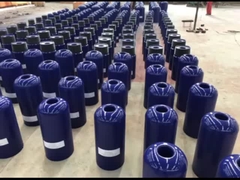
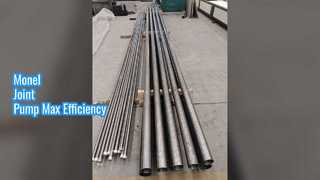
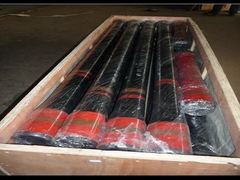
Brief: See the journey from feature description to real application in this concise overview. This video demonstrates the installation and operation of the Customized Service High Accuracy Sucker Rod Pump Barrel, showing how it is deployed downhole with tubing and the plunger assembly for enhanced oil extraction.
Related Product Features:
Larger bore design compared to rod pumps, enabling higher pump rates for increased production.
Ideal for large production wells, especially when used with an on-off connector.
Known as the strongest pump type available, built for demanding oilfield conditions.
Features a large flowing area, making it suitable for producing viscous oil efficiently.
Available in stationary heavy wall configurations with non-retrievable standing valves.
Offers multiple nominal diameters and plunger lengths for customized well applications.
Compatible with standard oil pipe and pumping rod diameters for seamless integration.
Designed for precise depth placement within the well via tubing for optimal performance.
FAQs:
What are the main types of tubing pumps based on seating mode?
Based on seating mode, the rod pump is divided into three types: THC pump (Stationary Heavy Wall, Cup Seating, Tubing pump), THM pump (Stationary Heavy Wall Mechanical Seating, Tubing Pump), and THD pump.
Why is the tubing pump considered suitable for viscous oil production?
The tubing pump has a large flowing area for fluid, which allows it to handle and efficiently produce viscous oil without clogging or reduced performance.
Can the standing valve be pulled out of a Stationary Heavy Wall Tubing Pump?
No, in the Stationary Heavy Wall Tubing Pump design, the standing valve cannot be pulled out, providing a fixed and reliable configuration for continuous operation.
What is the advantage of using a tubing pump over a rod pump in terms of bore size?
Given the same tubing size, the bore of the tubing pump is larger than that of the rod pump, resulting in a higher pump rate and increased production capacity.